Introduction
Scope
This document is the user guide and task reference for FXTSoft v2.0. It describes how Follow-up X-ray Telescope (FXT) data are calibrated, filtered, and converted into science products.
Einstein Probe is an X-ray astronomy mission of the Chinese Academy of Sciences (CAS). It carries the Wide-field X-ray Telescope (WXT, 0.5–4 keV) and the FXT. FXT follows up sources discovered by WXT and observes targets selected from the ground. It has two mirror modules, each with 54 nested Wolter-I paraboloid-hyperboloid shells (Figure 1). Each module focuses X-rays onto a PN-CCD (pn-junction charge-coupled device) detector, which records photon energy, position, and arrival time over 0.3–10 keV. The two PN-CCDs are oriented at 90° to one another in the focal plane.
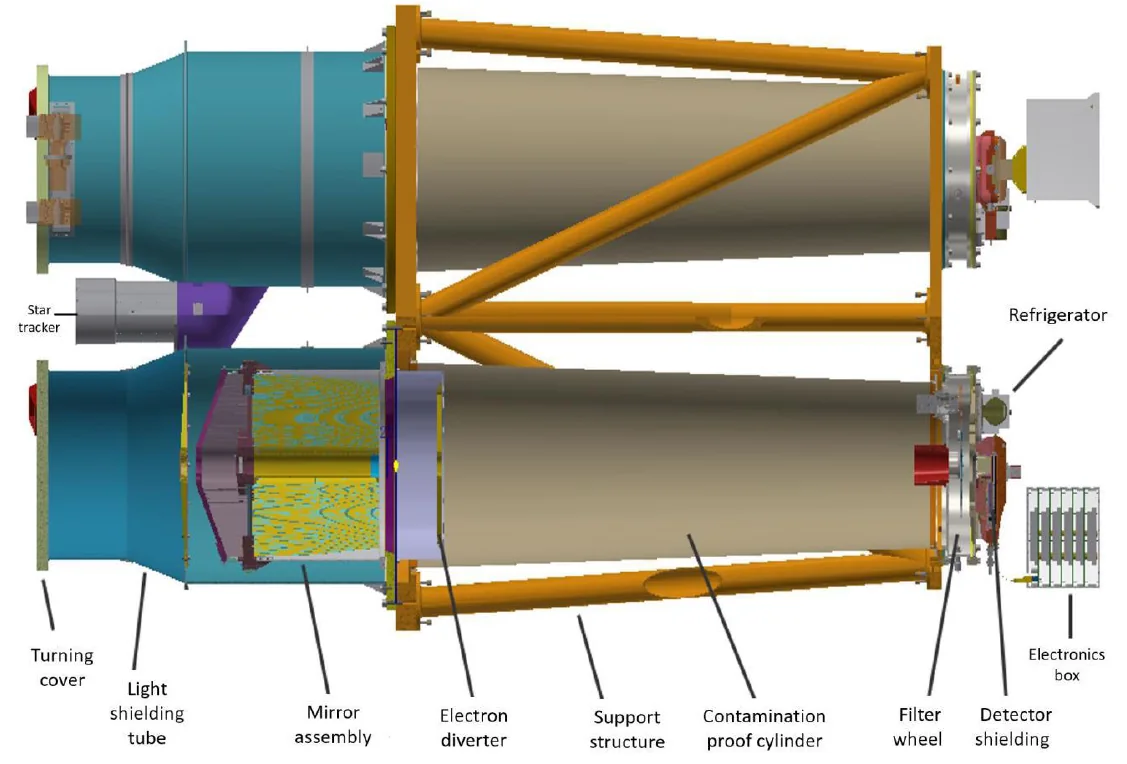
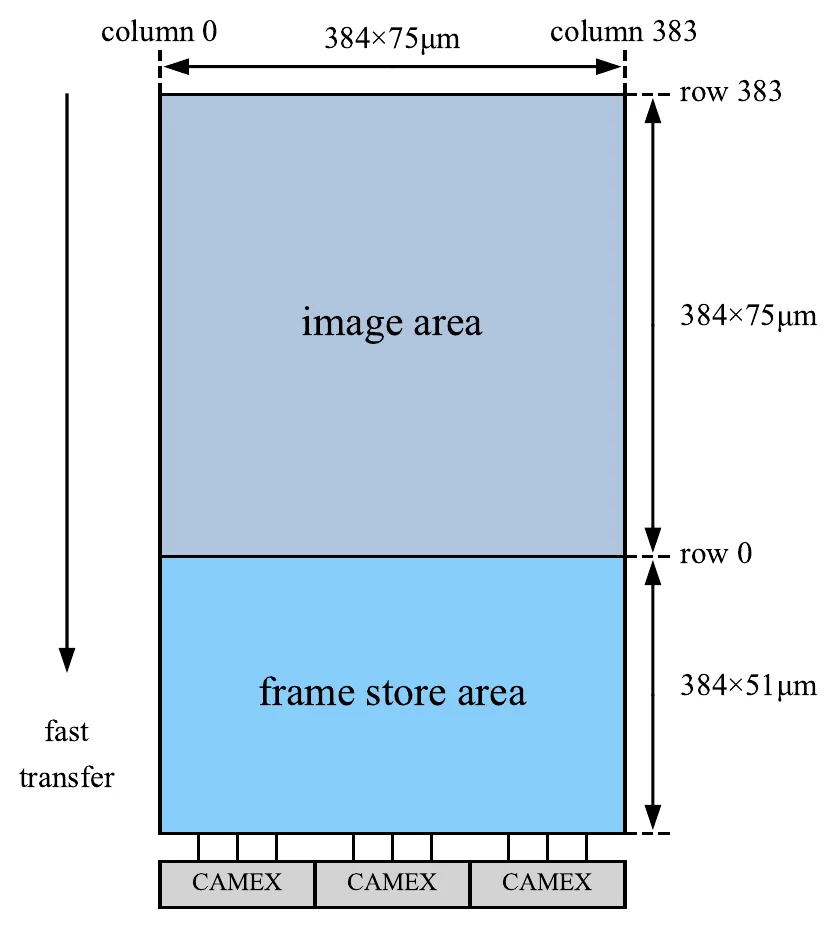
Figure 2 shows the layout of the PN-CCD. The PN-CCD has an imaging area and a frame-store area, each containing 384 × 384 pixels. The pixel size is 75 μm × 75 μm in the imaging area and 75 μm × 51 μm in the frame-store area. Charge collected in the imaging area is transferred to the frame-store area and read out in parallel by three CAMEX chips.
This guide describes the principles of FXT data processing and reduction. FXTSoft produces images, spectra, light curves, Ancillary Response Files (ARF), Redistribution Matrix Files (RMF), exposure maps, and background products. Its tasks follow the FTOOLS parameter convention and operate within an initialized HEASoft environment.
This guide assumes that the data have already been downloaded from the archive and that FXTSoft v2.0, HEASoft, and CALDB v2.0 have been installed and initialized. The maintained online edition is available at https://epfxt.ihep.ac.cn/docs/fxtsoft/.
Organization of this Guide
The Release Notes describe FXTSoft v2.0, command availability, and third-party code and licenses.
FXT Modes describes the observing modes and their implications for data reduction.
Data Files explains the observation layout, file naming, and event columns.
The Analysis Guide gives workflows for point sources, timing analysis, and extended sources.
Calibration Files describes CALDB v2.0 and its maintenance. The fxtchain Pipeline chapter documents the routine reduction from Level 1 to Level 2.
The Installation chapter covers building and initializing the software, and the Command Reference lists all available tasks and their parameters.
FXT was developed by the Institute of High Energy Physics (IHEP), Chinese Academy of Sciences (CAS), with participation from the Technical Institute of Physics and Chemistry, CAS, and contributions from the European Space Agency (ESA) and the Max Planck Institute for Extraterrestrial Physics (MPE).